IPROVF1 · PCIe Gen5 ×16 inference accelerator

Inference silicon that thinks faster.

MediaChipset accelerators put 48 TB/s of 3D-stacked memory beneath 1000 TFLOPS of FP8 compute on a standard PCIe card. Token generation becomes compute-bound at a batch of about 21 instead of several hundred, so the interactive, low-batch traffic that real applications generate runs at full efficiency.

Pre-silicon specifications are design targets.

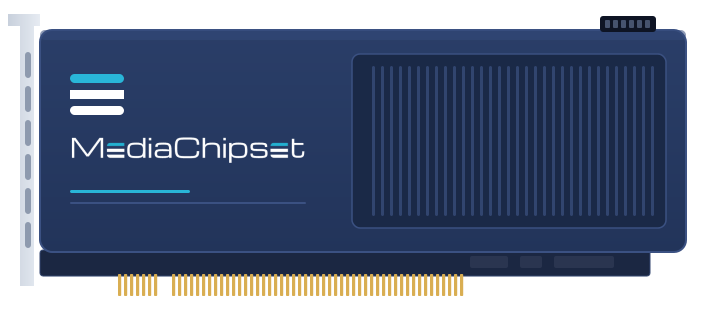
The IPROVF1 PCIe inference card
  • 1000TFLOPSFP8-E4M3 dense (native W8A8)
  • 500TFLOPSBF16 dense
  • 64GB3D-stacked DRAM on one die
  • 48TB/sDevice memory bandwidth
  • ≈21FLOP/BCompute per byte, balanced for decode

The inference bottleneck

Most inference runs on chips built for training.

Training GPUs ship roughly 400 FLOP of compute per byte of memory bandwidth, a ratio tuned for gradient computation. Token generation is different: every new token streams the entire model from memory.

To keep their arithmetic units fed, serving stacks batch hundreds of requests together, and users pay for it in latency. IPROVF1 inverts that balance with ten times the memory bandwidth of a 4.8 TB/s part, so a single conversation, agent step or robot control loop gets served at memory speed.

Where a single card trails a flagship GPU, on peak dense compute (1000 vs ≈1980 TFLOPS FP8) and capacity (64 vs 141 GB), two cards linked as IPROVF2 close the gap while doubling the bandwidth lead again to 96 TB/s.

How the architecture gets there

Memory bandwidth

TB/s, higher is better

IPROVF148.0 H200 SXM4.8

Batch-1 decode, 13B model in FP8

tokens per second, higher is better

IPROVF1≈3,700 H200 SXM≈370

Batch needed to reach peak compute

concurrent requests, lower is better

IPROVF1≈21 H200 SXM≈410

H200 values are NVIDIA-published dense figures for H200 SXM. IPROVF1 values are design targets; decode throughput is the bandwidth-bound ceiling (bandwidth ÷ model bytes).

Products

One architecture, from a single card to a full rack.

Start with a card that drops into any PCIe Gen5 server, or deploy a MediaChipset server integrated and validated with the serving stack.

PCIe add-in card

IPROVF1 Inference Card

A full-height PCIe Gen5 ×16 accelerator for 3B–20B models at interactive latency, with up to ≈50B parameters resident in FP8.

  • 1000 TFLOPSFP8 dense
  • 64 GB · 48 TB/s3D-stacked DRAM
  • 100 cores250,000 dual-mode PEs
  • Gen5 ×16128 GB/s host link
Rack server

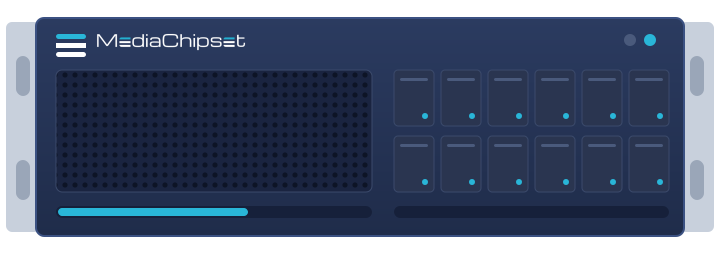
AI Inference Server

Four or eight IPROVF1 cards in a validated system, shipped with the driver, runtime and vLLM serving stack installed. Serve many mid-size models side by side, or pair cards for 50B–100B models.

  • Up to 8 PFLOPSFP8 dense
  • Up to 512 GBdevice memory
  • 384 TB/saggregate bandwidth
  • vLLM-readypre-installed stack

Why IPROVF1

Built for the traffic you actually serve.

10× decode where it counts

A 13B FP8 model sustains ≈3,700 tok/s at batch 1, against ≈370 tok/s on a 4.8 TB/s part.

Training-class compute, standard card

1000 TFLOPS FP8 and 500 TFLOPS BF16 dense in a card for any PCIe Gen5 server. No bespoke chassis or switch fabric.

64 GB, right-sized

3B–20B models fit entirely in FP8 with tens of gigabytes left for KV cache. No sharding, no collectives in the critical path.

FlashAttention in hardware

A native attention engine keeps the score tile on die, so long-context serving is limited by memory capacity, not on-chip storage.

Native W8A8 at exactly 2×

One dual-mode PE issues two FP8-E4M3 MACs or one BF16 MAC per cycle. Official FP8-dynamic checkpoints load directly.

Software ready before silicon

The MediaChipset SDK plugs into PyTorch, Hugging Face and vLLM today, validated model by model across LLM, vision-language and VLA workloads.

Validated software

Matches GPU results today.

The MediaChipset SDK is validated against the reference GPU implementation on text LLMs, vision-language and vision-language-action models, in both BF16 and FP8 W8A8. Bring-up on silicon is a port, not a rewrite.

  • Text LLMs
  • Reasoning models
  • Vision-language
  • Vision-language-action
  • BF16
  • FP8 W8A8
54/54BF16 answer-token agreement with the GPU reference across 9 LLMs
7/7VLA action tokens on a real robot image, action Δ = 0.0
1.00–1.10×End-to-end latency vs. the GPU reference, 10 models
1.92×FP8 GEMM speed-up over BF16, compute-bound

Measured on the IPROVF-Sim validation stack.

The IPROVF family

Moving up is a capacity decision, not a port.

Every configuration runs the same compiler, runtime and model formats.

ConfigurationFP8 computeMemoryTarget models
IPROVF11000 TFLOPS64 GB · 48 TB/s3B–20B at interactive latency; up to ≈50B resident
IPROVF2 (2×)2000 TFLOPS128 GB · 96 TB/s50B–100B
IPROVF4 (4×)4 PFLOPS256 GBup to ≈200B
IPROVF48 (48×)48 PFLOPS3 TBtrillion-parameter class

IPROVF1 and IPROVF2 are the standard packages; IPROVF4 and IPROVF48 are super-chipset configurations of the same architecture. Two devices form IPROVF2 over a 1.0 TB/s die-to-die link.

Customer data room

Datasheets and engineering documents, under NDA.

The full IPROVF1 datasheet and engineering documentation are shared with customers through a secure data room. Every download is logged and stamped to the recipient.

  1. Request access

    Tell us who you are and what you're evaluating. Use your business email.

  2. NDA verified

    We confirm a mutual NDA is in place, or send you one to sign, then approve your account.

  3. Download

    Set your password from the single-use invitation and download documents for the term of your NDA.